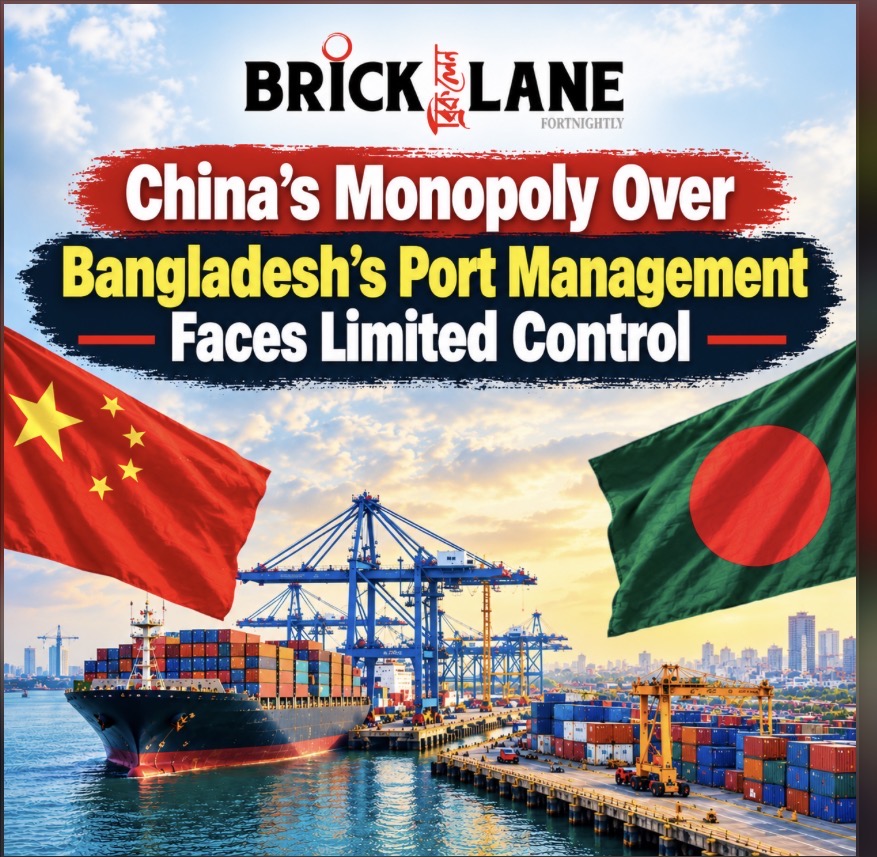
Global port operators are a fly in the soup for Chinese plan to monopolize seaports of Bangladesh With the Bangladesh Nationalist Party government turning to global port operators to modernize port operations in the country, the Chinese plan to further its strategic interests in the Bay of Bengal and beyond through gaining control of the seaports in Bangladesh has come up against a roadblock. During Bangladesh Prime Minister Tarique Rahman’s visit to Beijing last June, it was decided that China would develop the Mongla Port. Two state-of-the-art container jetties equipped with modern machinery would be constructed at Mongla Port under a China-funded project to enhance the handling capacity of the port. The project also included the construction of two container yards, one for loaded containers and the other for empty containers, and a hazardous cargo handling yard. But the deep seaport at Matarbari is coming up with Japanese investment. Now in a latest move, the Chittagong Port Authority has entered into an agreement for 30 years with the Maersk Group of Denmark, one of the leading terminal operators of the wo world, to design, finance, build and operate the Ladia Container Terminal at the Chittagong Port under a Public-Private-Partnership framework. Lately, successive governments in Dhaka have been avoiding total reliance on China for the development of seaports in Bangladesh by involving other foreign actors. Both the agreements for the development of Matarbari Port with concessional loans from Japan Overseas Cooperation Agency and for the development of Ladia Container Terminal in Chittagong with the Danish group were signed in 2025 when the interim government was running the show; Matarbari in April and Ladia in December. Former Prime Minister Sheikh Hasina had also taken note of the Indian sensibilities against increased Chinese commercial and technical presence at or near maritime assets of Bangladesh due to their strategic proximity with India and had refused to sanction the setting up of a deep seaport at Sonadiah with Chinese assistance. Explaining the need to invite the Maersk Group to develop the Ladia greenfield container terminal at Chittagong, Shipping Minister of Bangladesh Rabiul Islam has said that the country cannot afford any longer to leave its its maritime potentials underused. According to him, the Chittagong Port is currently in a “state of stagnation.” The management of ships, containers and cargo around Chittagong Port is not up to the required standard. Foreign companies with expertise in container and port handling can help overcome this existing state of stagnation. The Maersk Group is expected to bring in foreign direct investment of about $550 million at Ladia. This will be the single largest European equity investment in Bangladesh till now. The entry of APM Terminals B.V., a wholly owned subsidiary of A.P. Moller-Maersk, in the port sector of Bangladesh will also signal confidence to other international financiers and bring in additional FDI to the country. The Ladia terminal, the newest green port, will accommodate large container vessels double the size the Chittagong Port can currently accommodate, reduce freight cost per unit and enable direct shipping connectivity worldwide. There will be 24×7 port operations with night navigation facilities. The Patenga Container Terminal is the first terminal in Chittagong Port to be operated by a foreign firm. Saudi firm Red Sea Gateway Terminal is operating the Patenga terminal which was commissioned for operations in June 2025. On October 8, the contract was signed to hand over for 15 years the operation, maintenance and modernization of the New Moorings Container Terminal, the largest of the four container terminals of Chittagong Port, to DP World; a firm from the United Arab Emirates. The Chittagong Port Authority will retain its ownership, land and infrastructure and regulatory oversight. The handing over of the terminal to a foreign operator was questioned by left-wing labour unions, but the government has explained the deal will bring modern technology and operating standards to the port; reducing waiting time for ships. Chinese firms are currently engaged in supplying port machinery at Chittagong Port, building nearby industrial parks and also positioning themselves for upcoming terminal modernization projects. The construction of the China Economic and Industrial Zone at Anwara in Chittagong has started on 800 acres under a government-to- government initiative between Bangladesh and China. The plan is to attract investments from China and other countries in export-oriented industries. Bangladesh had been inviting Chinese investments since 2010 to develop the Chittagong Port. China has set up a single point mooring for direct offloading of oil into pipelines for the Chittagong refinery. In 2023 an oil tanker, for the first time, unloaded oil through the single point mooring system built by the China Petroleum Pipeline Bureau. But the decision to award the contract for the operation and maintenance of the single point mooring system to a Chinese company was cancelled as the contract had been awarded without a competitive bidding. Bangladesh Petroleum Corporation was asked to go for a fresh open international tender to select an operation and maintenance firm through a process of competitive bidding. Now the system has moved closer to regular operations with the Cabinet Committee on Government Purchase lately deciding to award the contract to state-owned Indonesian firm, PT Pertamina Trans Kontinental, to operate and maintain the facility at Cox’ Bazar for five years. Thus, the authorities in Bangladesh are now preferring other international companies rather than Chinese enterprises for leasing of terminals and terminal operations at Chittagong Port which is the main base for the export and import trade of Bangladesh. Beijing’s plan to increase its presence in Chittagong through ventures like the Anwara project will serve its commercial interests. China’s presence at Mongla while developing the facilities at the port will help Beijing in its s garments trade; Dhaka being the hub of the garment industry in Bangladesh. Mongla Port is closer to Dhaka than the Chittagong Port. For the extension of Chinese hegemony in the Indian Ocean region to control key shipping routes for global energy supplies or for the promotion of its ‘string of pearls’ strategy of surrounding India, however, the control of Mongla Port will not be sufficient. Mongla, being a river port situated about 100 km from the sea, is not suitable as a naval hub. And at Chittagong, with the presence of global players in port and shipping, backed by major western powers, a Chinese naval presence will not go unnoticed. The approach of the government in Dhaka thus appears to be one of encouraging Chinese investments to strengthen the export-led sector of the Bangladesh economy while denying Beijing the opportunity of using the seaports of the country to promote the strategic interests of China.