
Juyel Raaj –
Kashmir, known as the heaven on earth, appears repeatedly like a dream in the films we see and in stories and literature through various metaphors. But like darkness beneath a lamp, for years after years, beneath that dream, Kashmir is not only offering whiteness but also the red of blood, which negatively affects the politics of the subcontinent. I have had the good fortune to see many countries in Europe, yet the greed to see Kashmir has remained in my mind. I visited India just two months ago, but despite having the desire to go to Kashmir, I did not have the courage because of the fear from last year’s Pahalgam incident. And not just me; after this incident, the entire tourism system of Kashmir collapsed.
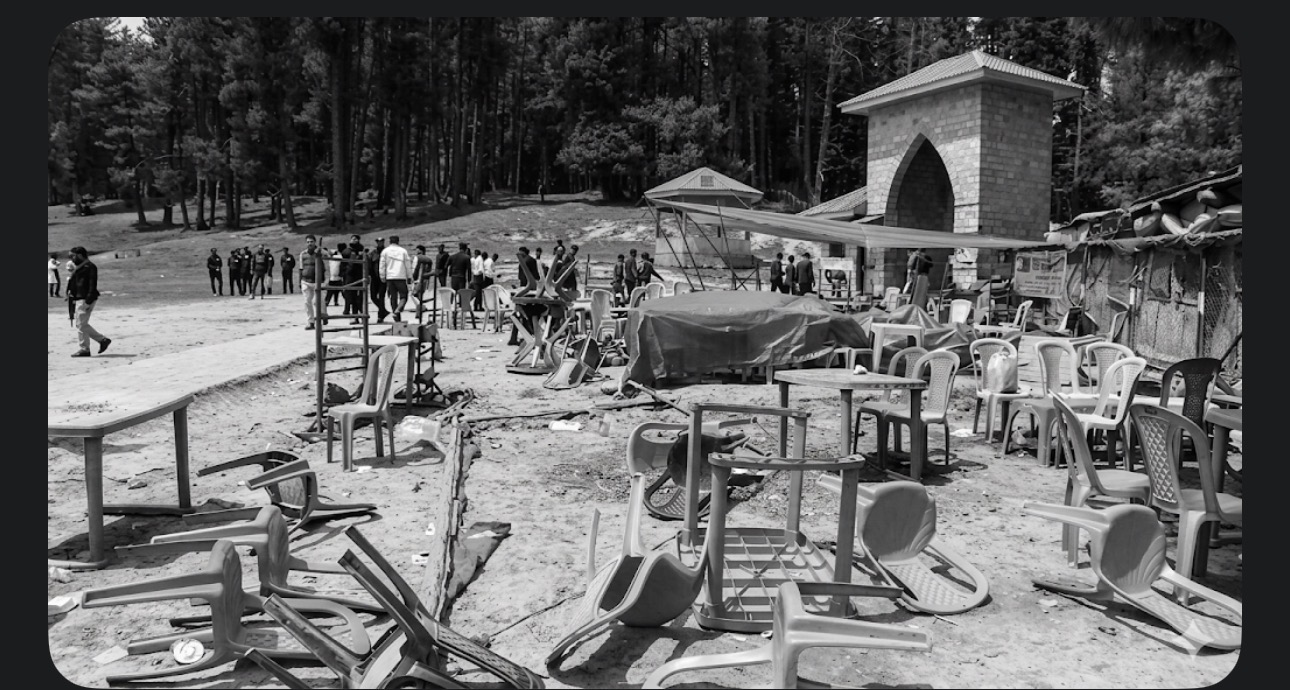
An epic could be written about the bloody history of Kashmir, and indeed, it should be—where the lamentations of hundreds of Muslim mothers will exist, and the bloody history of wiping out the Kashmiri Pandits will also remain. But last year at this time, on April 22nd, twenty-five people were brutally killed. Although India blamed Pakistan for this attack, Islamabad denied that allegation. Initially, an organization called ‘The Resistance Front’ (TRF) claimed responsibility for the attack. According to the United States, this organization is a ‘proxy’ group for Lashkar-e-Taiba, a terrorist group identified by the United Nations. Although later, TRF withdrew their claim. Subsequently, India permanently deployed at least 500,000 troops in Kashmir.
In response to this Pahalgam militant attack, a significant number of Pakistani soldiers and terrorists were killed in ‘Operation Sindoor’ conducted by India in May 2025. According to Indian sources, more than a hundred, some say more than 150, or at least 35-40 Pakistani soldiers were killed in this operation. Additionally, several militant bases were destroyed.
Has anyone actually won in this unequal bloodshed? Neither India, nor Pakistan, nor the religious extremist groups. Humanity has sunk into darkness in the middle. Innocent lives have been lost. Personally, I am not in favor of criminals or loss of life; I am in favor of punishing the criminal. Because when a judge does not have the power to create life, they should not have the power to destroy it either.
When people take human lives using only religious belief as a weapon, it does not only destroy the peace of a region—it shakes the very moral foundation of entire human civilization. We are living in an era where religious extremism is not just a political ideology; it is a foul, bloody playing field where the existence of humanity is being put at risk.
Any extremism is a desperate attempt to prove deep-seated hatred, intolerance, and one’s own superiority. They carry out such atrocities under the guise of religion for their own interests, which creates a horrific terror at every level of society. These people believe that their religious superiority will validate their violence. This mindset is so deadly that it leaves no room for logic; only the fire of rage and envy drives them.
When this religious division turns into political and social division, the consequence is inevitably horrific. When people start to distrust each other, human values like cooperation, empathy, and tolerance are crushed. This division is not just a problem between two groups; it is pushing the whole world into a darkness of helplessness. Religious extremism only gives birth to wars and creates human wounds that are carried from generation to generation. Religious hatred and division like in the Indian subcontinent are not present in any other country in modern times. We—Bangladesh, India, Pakistan—are still repeatedly ravaged by the poison of that religious extremism.
Against this, we need collective, moral, and firm steps. We need that voice which will raise a sound against this hatred and division. Come, let us collectively stand up against this extremism. Let us prove that despite differences in religion or belief, as humans, we are all one. For the sake of humanity, we must collectively stop this bloody game and build a tolerant, peaceful, and humane world. Religious extremism sows the seeds of hatred, distrust, and envy towards others in the name of religion. It does not remain limited to specific groups; it enters every level of society and harms human values. Precious assets like tolerance and peace are lost. The wars and conflicts seen worldwide today have religious extremism and intolerance as one of their root causes.
You might remember that after the armed militant attack, the local Muslim community, especially the pony ride operators, played a significant role in saving the attacked tourists, and local Muslim youths helped the injured. After this incident, common people in the valley held peace marches shouting the slogan “Hindu-Muslim Bhai-Bhai” (Hindus and Muslims are brothers) and protested the attack.
To dispel this darkness, military or political steps alone are not enough. The most important thing is the courage to overcome religious division through mutual respect, empathy, and dialogue. We must repeatedly stand up against extremism; despite differences in religion or belief, as humans, we are all one. For the sake of humanity, we must collectively emerge from this darkness and build a tolerant and peaceful world.
Writer: Journalist and Columnist