Sushanta Das Gupta, London:
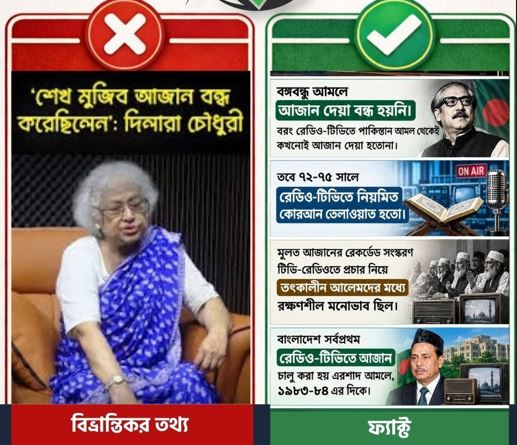
A viral assertion claiming that the broadcast of the Islamic call to prayer (Azan) on state radio and television was prohibited and that madrasas were shut down during the post-independence governance of Sheikh Mujibur Rahman has been determined to be false. Historical records and official documentation from the 1972–1975 period directly contradict these claims.
The claim gained traction on social media following public remarks attributed to political analyst Dilara Chowdhury. In circulating clips and posts, she alleged that religious practices were suppressed during the early years of Bangladesh’s independence, specifically asserting that religious broadcasts were removed from Bangladesh Betar and Bangladesh Television, alongside widespread closures of Islamic religious schools (madrasas).
Fact-checking investigations and historical evidence demonstrate that state broadcasting policies during Sheikh Mujibur Rahman’s administration maintained dedicated slots for daily Quran recitations, the broadcast of Azan, and other religious programs. Archive records from the Ministry of Information and Broadcasting confirm that religious broadcasting remained an integral part of the state media’s daily schedule throughout the 1972–1975 era.
Furthermore, educational records from the Bangladesh Madrasah Education Board refute the claim regarding the closure of Islamic institutions. Madrasa education operated under state recognition, and budget allocations for registered madrasas continued during that tenure. Historical records also show that the Islamic Foundation Bangladesh was formally established under Sheikh Mujibur Rahman’s government through a presidential order in March 1975, designed specifically to patronize Islamic research, scholarship, and religious education.
Independent fact-checkers and historical researchers have classified the statements regarding the prohibition of the Azan on state media and the shutdown of madrasas during this period as unfounded and historically inaccurate.